
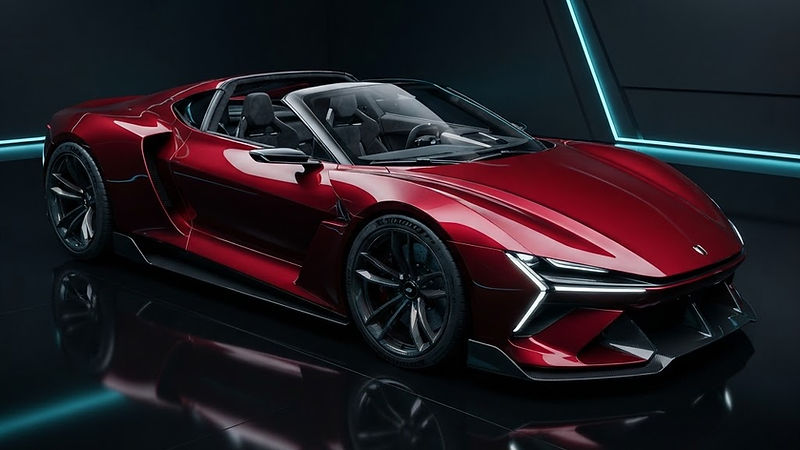
Second generation — the flying Roadster, with SpaceX thrusters
Roadster
Announced 2017, redesigned October 2026Reservations open — production planned for 20282-door, 1 or 2-seat electric hypercar (Rocket trim: air ready)
The flying Roadster — SpaceX thrusters, under a second to 60 mph.
The 2026 flying Roadster
In the Rocket configuration the redesigned Roadster carries ten cold-gas thrusters developed with SpaceX, fed by 600 litres of compressed air. Tesla demonstrated 0 to 60 mph in 0.81 seconds in October 2026 and described thrusters that can lift and rotate the car in mid-air. Performance and Thrust trims are road and race ready; Rocket is air ready, and not offered in every region.
Overview
The new Roadster is Tesla's halo car: a two-seat hypercar with dual rear motors, butterfly doors and, in its upper trims, cold-gas thrusters developed with SpaceX that can accelerate it from 0 to 60 mph in under one second.
The story
The new Roadster arrived by surprise. At the end of the Semi event on 16 November 2017, a trailer opened and the car drove out to the Beastie Boys' Sabotage. Musk announced 1.9 seconds to 60 mph, 620 miles of range, and a $200,000 price with a $50,000 deposit — then Tesla spent eight years not building it.
Production slipped from 2020 to 2021, then 2023, then 2025. In November 2025 Musk said the car would arrive in 2027 or 2028, and in October 2026 Tesla showed a redesigned two-seat Roadster with three configurations: Performance, Thrust and Rocket, the last two fitted with cold-gas thrusters built with SpaceX, connected to 600 litres of compressed air.
At the reveal Tesla demonstrated 0 to 60 mph in 0.81 seconds, and engineering vice-president Lars Moravy described ten thrusters that can lift and rotate the car in mid-air. Musk called it “the best of the last of the human-driven cars” — a halo machine for a company that now spends most of its story on autonomy and robots.
Full specifications
Powertrain
- Motors
- Dual rear motors, one per rear wheel
- Layout
- Rear-motor, rear-wheel drive
- Peak power
- Over 1,341 hp (1,000 kW) in Performance and above
- Thrusters
- Cold-gas thrusters developed with SpaceX — rear-mounted on Thrust, 10 thrusters around the car on Rocket, fed by 600 litres of compressed air
Performance
- 0–60 mph
- Under 1 second in Thrust trim; 0.81 s demonstrated with the thruster system. The 2017 reveal claimed 1.9 s
- Top speed
- Over 250 mph claimed
- Range
- 310–320 mi claimed in 2026 — the 2017 reveal claimed 620 mi
- Weight target
- Under 3,700 lb (1,700 kg)
Charging
- DC fast charging
- Over 500 kW on V4 Superchargers
- Home charging
- High-power onboard AC charger
Body & interior
- Doors
- Butterfly doors
- Roof
- Removable targa panel
- Seating
- 2 seats (Performance, Thrust); 1 seat in the invitation-only Rocket
- Wheelbase / width
- 111.2 in / about 79 in
- Designer
- Franz von Holzhausen
Production
- First shown
- 16 November 2017, driven out of a Semi trailer after the truck event
- Redesigned
- Revealed 15 October 2026 as a two-seat car with three trims
- Production
- Planned for 2028 at Gigafactory Texas
- Trims
- Performance (road ready), Thrust (race ready), Rocket (air ready — not available in all regions)
Records and firsts
- Would be the quickest accelerating production car ever built — 0.81 s to 60 mph demonstrated in 2026
- The first production car designed with cold-gas thrusters, developed with SpaceX
- The 2017 reveal claimed 1.9 s to 60 mph, quicker than any production car at the time
- Reached over 1 million reservations interest after the 2017 unveiling
- The first Tesla with a 10,000 Nm torque claim — announced in 2017
Every version
| Version | Years | Price | Notes |
|---|---|---|---|
| Performance | 2026– | from $200,000 | Road ready — $50,000 reservation deposit |
| Thrust | 2026– | $250,000 | Race ready, two seats, rear cold-gas thrusters, sub-1 second 0–60 mph |
| Rocket | 2026– | by invitation | Air ready, single seat, 10 cold-gas thrusters — not offered in all regions |